

Considering an upholstered bed to elevate your bedroom aesthetic? The Tilly Upholstered Bed has been a staple in my home for years, and I’m excited to share my comprehensive, honest review. This deep dive covers its pros and cons, available fabric options, headboard height considerations, and how it stacks up against similar popular beds. Discover if the Tilly bed is the perfect blend of style, comfort, and value for your space!
Transforming a bedroom can significantly impact the overall feel of your home. About eight years ago, during the remodel of our Connecticut guest bedroom, I set out to replace a basic headboard with a sophisticated, fully upholstered bed. After extensive research and countless hours of comparing styles, prices, and reviews, I ultimately selected the Tilly Upholstered Bed. The change was remarkable; it instantly injected a sense of luxury and warmth into the room, creating a focal point that truly defined the space.
My satisfaction with the Tilly bed didn’t wane over time. In fact, six years later, when it was time to furnish the primary bedroom in our current home, I made the easy decision to purchase the exact same bed in a larger size. This enduring loyalty speaks volumes about its quality, aesthetic appeal, and overall value. Today, I’m peeling back the layers to share every detail about the Tilly upholstered bed, aiming to equip you with all the information you need to make an informed decision for your own sanctuary. Let’s begin by showcasing how beautifully it integrates into different settings with a few illustrative photos.
(Please note: This post includes commissionable links. For more information, you can review my disclosure statement {here}.)
The Enduring Style of the Tilly Upholstered Bed
When I was searching for a fully upholstered bed, my goal was to find an option that exuded quality and style without breaking the bank. The Tilly bed (found {HERE}) stood out as one of the most affordable upholstered beds that genuinely avoided a “cheap” appearance. Its design is a testament to classic elegance, featuring a tall, stately headboard gracefully accented by subtle curved “wings” on each side. This wingback design not only adds a touch of architectural interest but also creates a cozy, enveloping feel, transforming the bed into a luxurious retreat. The entire frame—headboard, sideboards, and footboard—is meticulously upholstered, contributing to a cohesive and polished look. This comprehensive upholstery is key to achieving that high-end, designer aesthetic.
To give you a clear picture of its versatility, here’s how the Tilly bed presented itself in the queen size within the guest room of our previous home, radiating welcoming comfort:
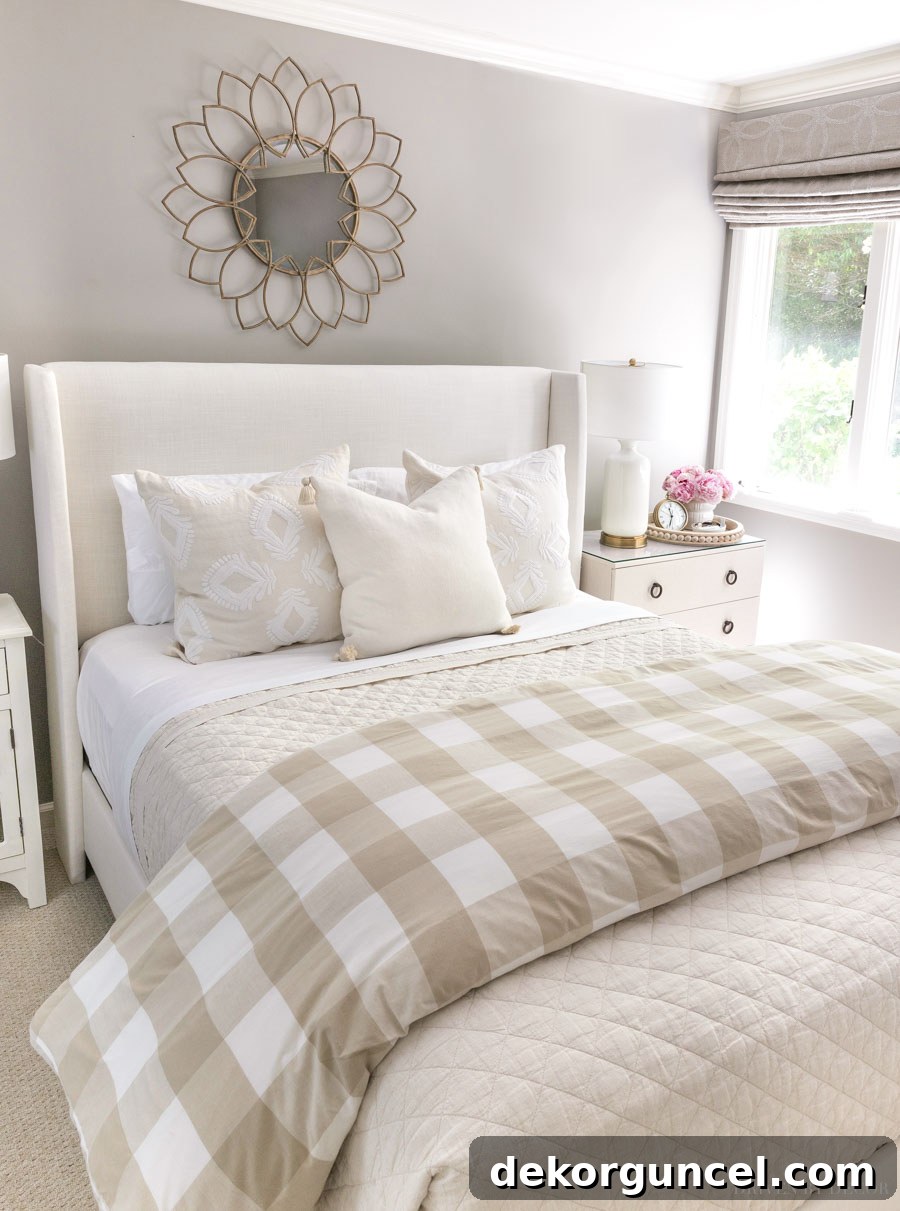
Complementary Decor Sources: Mirror over Bed | Quilt (flax color) | White and beige check duvet (similar) | 24″ Embroidered Medallion Pillow covers | 20″ White Tassel End Pillow Cover (similar) | White Bedside Lamps (similar) | Round Wood Beaded Tray | Clock
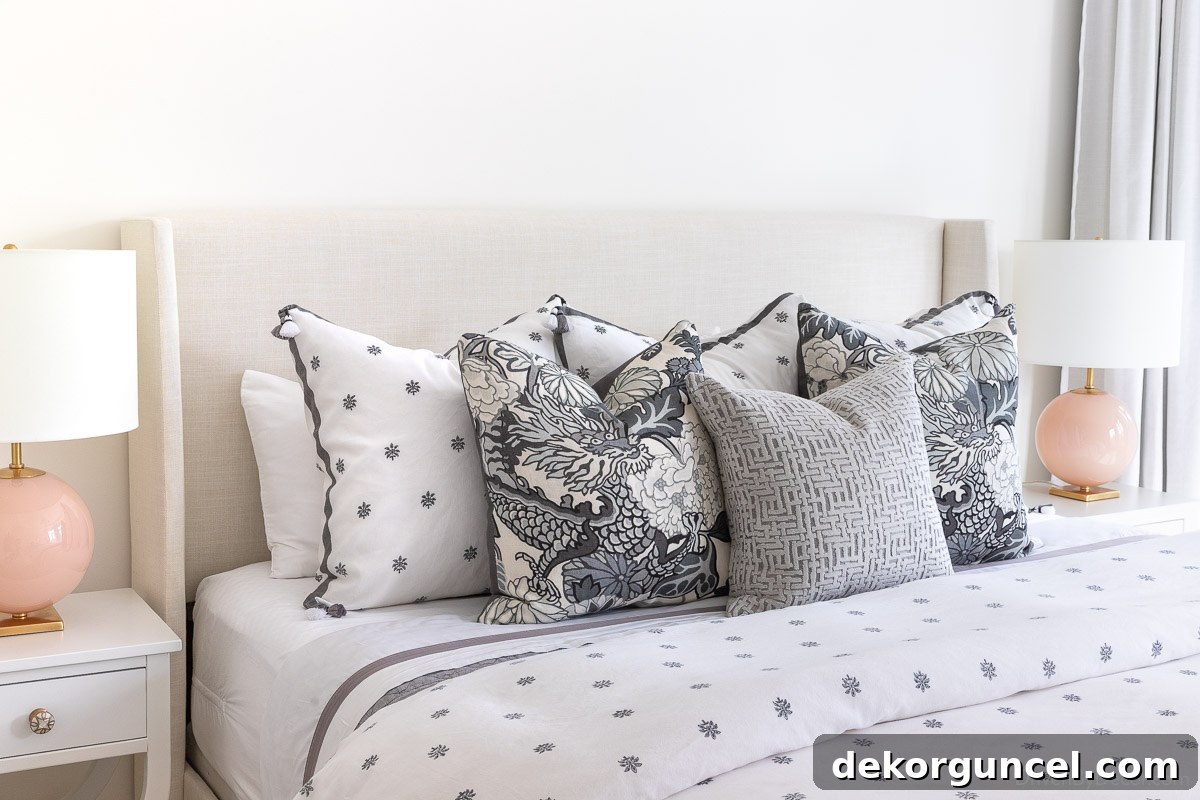
And for a broader perspective, observe its majestic presence in the king size, anchoring the primary bedroom of our current home with undeniable sophistication:

Complementary Decor Sources: Nightstands | Blush table lamps | Gray dragon pillow covers | Chandelier | White drapes | Bedding is no longer available
The Tilly’s design seamlessly blends into various interior design styles, from modern farmhouse to transitional or even traditional, making it a truly versatile piece of bedroom furniture. Its clean lines and tailored upholstery provide a neutral yet impactful backdrop, allowing other decorative elements in your room to shine, whether you prefer bold colors, intricate patterns, or serene monochromatic palettes. The plush look of the upholstered frame instantly elevates the comfort factor, inviting you to relax and unwind in style.
Tilly Upholstered Bed: Detailed Pros & Cons
Now that you’ve seen the Tilly bed in action, let’s delve into the specific advantages and disadvantages I’ve experienced over years of ownership. Understanding these points will help you gauge if this Tilly upholstered bed aligns with your expectations and lifestyle.
Pro: Exceptional Value and Price Point
Undoubtedly, the price was a pivotal factor in my initial decision and remains one of the Tilly bed’s most compelling strengths. Fully upholstered beds, particularly those with a substantial, well-designed headboard, typically come with a significantly higher price tag than simple headboards or metal frames. While the Tilly bed is certainly an investment, it offers an incredible value, often costing about one-third of the price of comparable upholstered beds I considered during my initial search. This makes it an outstanding choice for anyone seeking a budget-friendly upholstered bed that doesn’t compromise on aesthetics.
Adding to its immense value, the Tilly bed ships for free. This might seem like a minor detail, but for large furniture items like upholstered beds, delivery fees can easily tack on an additional $200-$300 or more to the total cost. Free shipping is a huge advantage that further enhances the Tilly’s affordability and overall appeal. While prices fluctuate based on sales and promotions, you can often find the king-size Tilly bed on sale for under $1000, including free shipping. To put this in perspective, consider Pottery Barn’s Harper bed, which shares a similar tall headboard aesthetic. The Harper bed typically ranges from $1899-$2799 for a king size, depending on your fabric selection, with an additional shipping fee that can reach $379. This brings the total cost for the Harper bed to between $2279 and $3079, illustrating how the Tilly bed consistently offers a similar look at a fraction of the cost—typically between one-third to one-half the price.
Pro: Efficient Delivery Times
Beyond the cost savings, the efficiency of the Tilly bed’s shipping is another significant benefit. Wayfair typically estimates a delivery time of approximately 2-3 weeks for all fabric choices, though in my personal experience, both of my Tilly beds arrived in just about a week. This rapid turnaround is a considerable advantage, especially when compared to other premium furniture retailers. For instance, while the Harper bed offers one fabric choice with a comparable 1-3 week delivery, most of its other fabric options come with extensive lead times, ranging from 6+ weeks to over 12 weeks. When you’re eager to complete your bedroom transformation, quick delivery can make a substantial difference, making the Tilly bed a standout for its promptness.
Pro: Ideal Headboard Height
The height of a headboard is a crucial design element often overlooked but vital for creating a balanced and luxurious bedroom aesthetic. It’s counterproductive to invest in a beautifully designed headboard if it gets completely obscured by decorative pillows. A common issue with many beds is a headboard that’s too low, disappearing once bedding and pillows are arranged. For example, while I appreciate the side profile of {this classic upholstered bed},

its front view reveals why promotional images often show pillows slumped. With a mere 35″ height, a standard arrangement of decorative pillows would completely cover it:

If you prefer to stand your decorative pillows upright, as I do, a headboard this low would render it practically invisible, negating its design impact.
For beds utilizing both a box spring and a mattress, I strongly recommend a minimum headboard height of 50 inches to ensure a substantial visual presence. Our guest room’s {beadboard bed}, standing at 52 inches high, serves as a good benchmark; I wouldn’t opt for anything significantly shorter than that:

Sources: Round mirror | Pinch pleat curtains in snow white | Embroidered stripe pillow shams | Embroidered stripe duvet cover | Blue and white block print pillows (similar) | White tassel pillow | Cane bench | Nightstands | White Lamps (similar)
The Tilly bed excels in this aspect, boasting a generous headboard height of 55 inches. This ensures that even with large, plush 26-inch pillow shams, several inches of the beautifully upholstered headboard remain prominently visible above the bedding, creating that coveted layered and luxurious look that defines a well-appointed bedroom.
Having highlighted its advantages, let’s now address some aspects that might be considered drawbacks of the Tilly upholstered bed.
Con: Assembly Required
One primary distinction between the Tilly bed and its more expensive counterparts is the assembly requirement. The Tilly bed arrives conveniently packaged in two boxes, necessitating self-assembly. In contrast, premium upholstered beds, such as Pottery Barn’s Harper Bed, often include white glove delivery services where assembly is handled by the delivery team. While it’s certainly possible to assemble the Tilly bed on your own, the process is significantly smoother and quicker with two people. The accompanying instructions are remarkably clear and easy to follow, detailing each step effectively. My experience, working with another person, involved just over an hour for complete assembly, with the majority of that time dedicated to minor adjustments to ensure the sideboards and footboard aligned perfectly with the headboard, creating a seamless fit.
For those who prefer to skip the DIY route, Wayfair does offer the option to pay extra for professional in-home assembly of the Tilly bed. Although I haven’t personally utilized this service, it provides a convenient alternative. Additionally, platforms like Task Rabbit offer a great solution for finding local help to assemble your furniture, providing flexibility if you’re not inclined to tackle the task yourself.
Con: Headboard Doesn’t Extend to the Floor
Another construction difference that sets the Tilly upholstered bed apart from pricier options is the design of its headboard. Unlike some high-end beds where the upholstery extends all the way to the floor, the Tilly’s headboard frame concludes approximately 24 inches from the floor. This design choice is typically implemented to keep manufacturing costs—and thus, the retail price—lower, making the bed more accessible. In the image below, where I’ve pulled our mattress away, you can clearly see where the upholstered portion of the headboard ends:
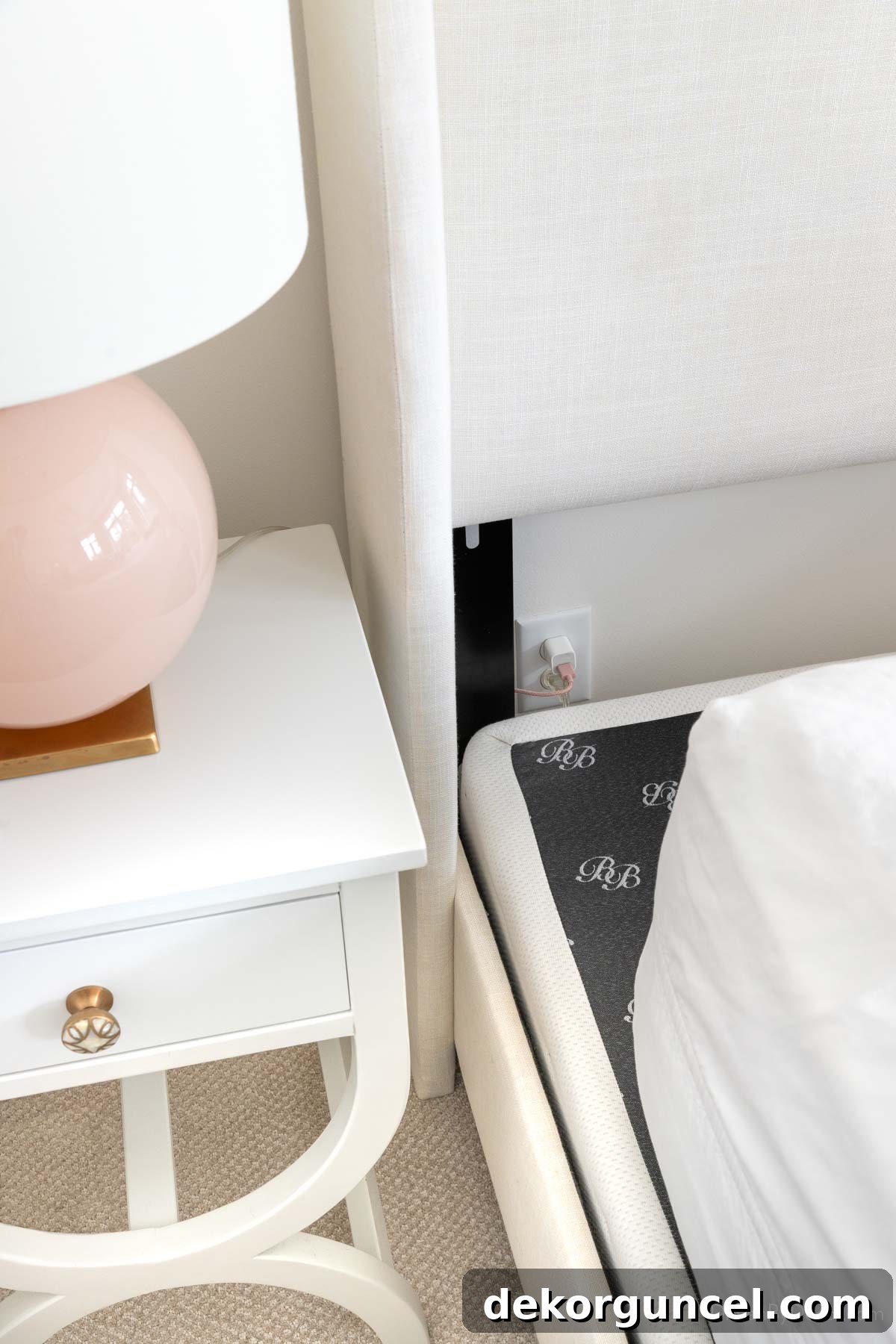
However, this is largely a non-issue in practice. As long as the top of your mattress sits higher than the bottom edge of the upholstered headboard (a point we’ll explore further in the box spring section), this detail remains completely hidden and doesn’t detract from the bed’s luxurious appearance. In fact, I’ve found this particular design to be quite advantageous in our bedroom, as it provides easier access to wall outlets located behind the bed, which would otherwise be completely blocked by a floor-length headboard.
Con: Limited Performance Fabric Options
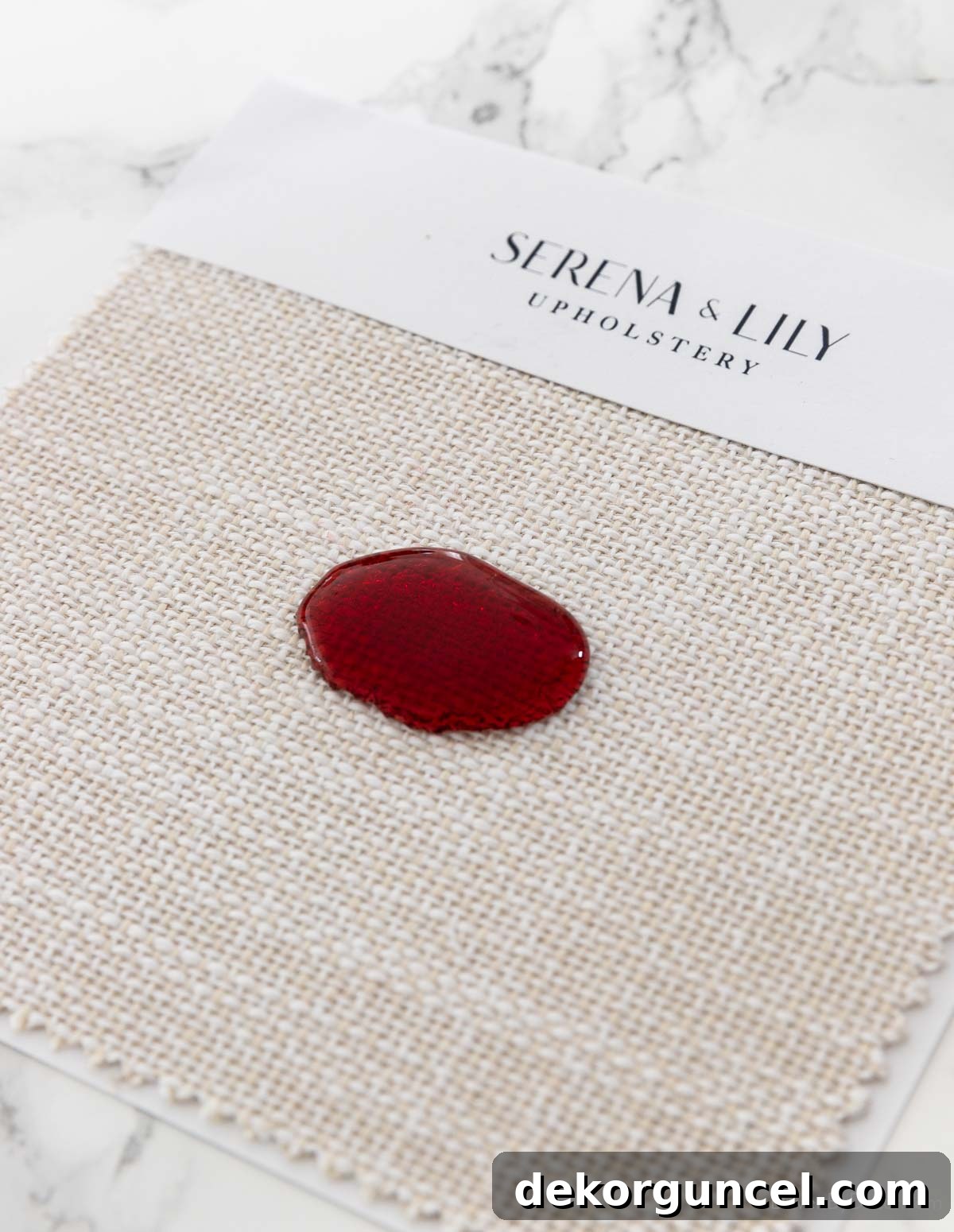
A notable limitation of the Tilly bed is the absence of performance fabric options within its selection. Performance fabrics, such as Sunbrella, Crypton, and Perennials, are celebrated for their exceptional durability and ease of care. These advanced materials are specifically engineered to be stain-resistant, fade-resistant, and remarkably easy to clean, making them ideal for high-traffic areas or homes with children and pets. Liquids, even notoriously problematic ones like wine, simply bead up on the surface, allowing for quick and effortless cleanup, as demonstrated here:
The primary reason for their exclusion from the Tilly bed’s offerings is likely their higher cost. Incorporating performance fabrics would significantly increase the bed’s overall price, potentially moving it out of its accessible price bracket. While I haven’t encountered any major stains on our Tilly bed, I’ve successfully managed minor marks using a small amount of {this Folex}—my preferred carpet and upholstery cleaner—applied to a damp microfiber cloth. For general maintenance and longevity, regular vacuuming with an upholstery attachment is also recommended to keep the fabric looking fresh and free of dust and debris.
Now that we’ve thoroughly reviewed the advantages and disadvantages, let’s turn our attention to the aesthetic choices available with the Tilly bed: its fabric options.
Tilly Bed Fabric Choices: Finding Your Perfect Shade
The Tilly bed offers an impressive selection of over 30 fabric options, providing a wide range of possibilities to match various decor schemes. For both of my Tilly beds, I ultimately chose the “Zuma White” textured linen fabric. This particular fabric is a true marvel due to its chameleon-like quality; it subtly shifts between white, cream, and a light beige depending on the ambient lighting and the surrounding colors in the room. This versatility makes it incredibly forgiving and easy to integrate into diverse palettes. In our primary bedroom, for instance, where I’ve incorporated a mix of white elements including white walls, nightstands, and drapes, the Zuma White fabric blends seamlessly, creating a cohesive and serene atmosphere:

Before settling on Zuma White, I carefully considered a couple of other popular light-colored options: Classic Talc Linen (previously known as Linen Talc) and White Twill. Here’s a comparative look at these three fabrics, highlighting their subtle yet distinct characteristics:
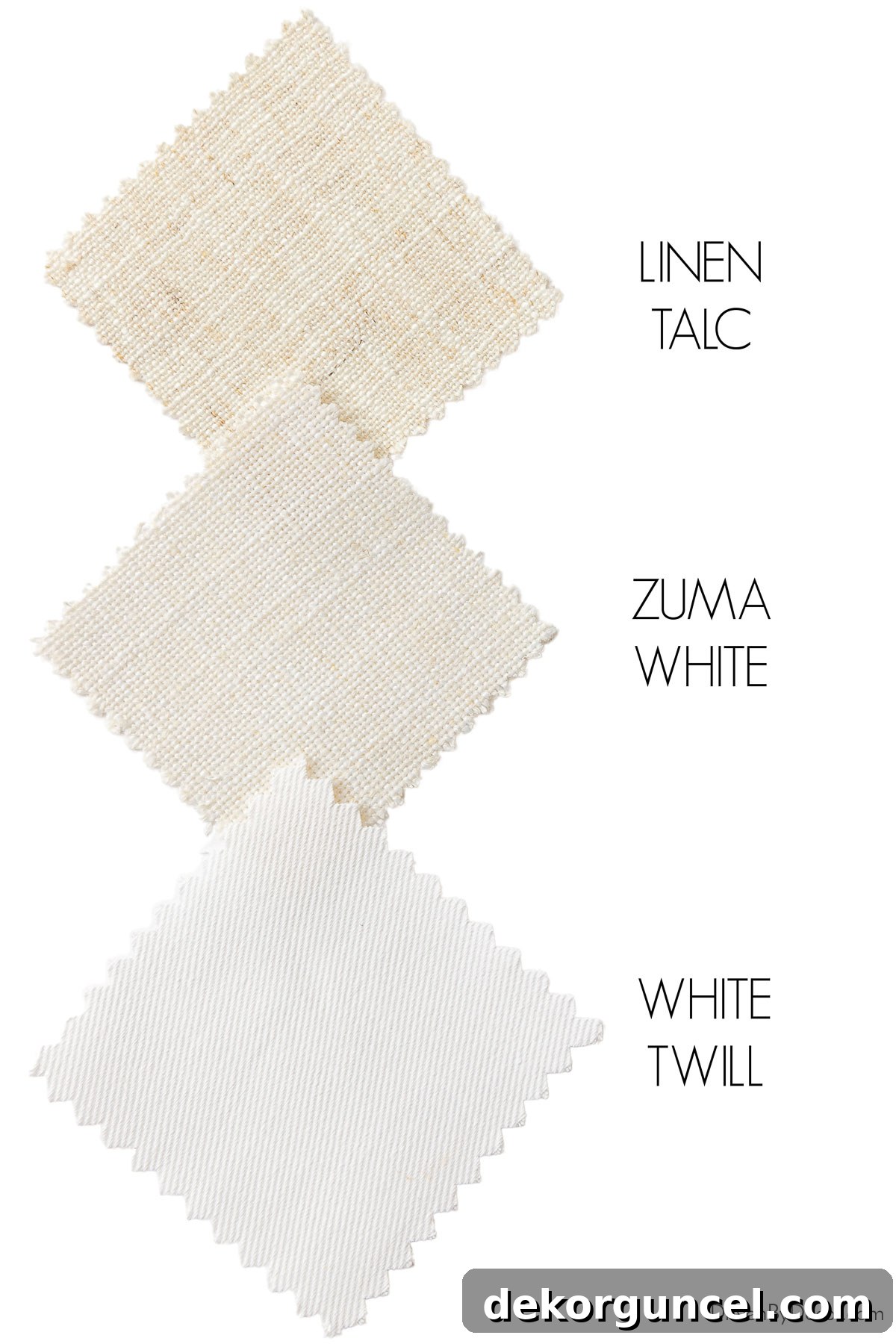
When comparing Classic Talc Linen with Zuma White, the Classic Talc Linen leans more towards a light beige with slightly darker and lighter threads woven throughout, giving it a richer, more textured appearance. Zuma White, in contrast, offers a more consistent, creamy white tone across the fabric sample. The subtle texture of Zuma White adds depth without introducing a varied color profile, making it a very pure and versatile off-white option.
White Twill, on the other hand, presents a significantly cooler white. This means it has more blue undertones than yellow, resulting in a very bright, almost stark white. In my opinion, White Twill can be a bit too intense for an upholstered bed, which often benefits from a softer, warmer hue to enhance the sense of comfort and coziness in a bedroom. The choice between these fabrics ultimately depends on your desired warmth, brightness, and how they interact with the other colors and lighting in your specific bedroom setting. I highly recommend ordering fabric samples if available, as colors can appear vastly different on screen compared to in person.
Essential Information: Do You Need a Box Spring with the Tilly Bed?
Yes, definitively, you absolutely DO need to use a box spring with the Tilly bed. This is a critical point that cannot be overstated. The bed slats provided with the Tilly bed are designed to support a box spring and mattress combination, but they are not robust enough to provide adequate support for a mattress alone. Attempting to use only a mattress without a box spring would not only compromise the longevity and comfort of your mattress but also lead to structural instability. Furthermore, from an aesthetic standpoint, foregoing a box spring would result in the bed sitting quite low, creating an unsightly gap between the top of your mattress and the bottom edge of the upholstered headboard, diminishing the bed’s elegant look.
I currently use a 9-inch box spring with my Tilly bed, primarily because it’s the size I already owned. While it functions perfectly well, if I were to purchase a new box spring specifically for this bed, I would opt for a 7-inch model (I highly recommend {this box spring}). The reason for this recommendation is that my 9-inch box spring extends approximately 2 inches higher than the upholstered side rails of the bed, as illustrated here:
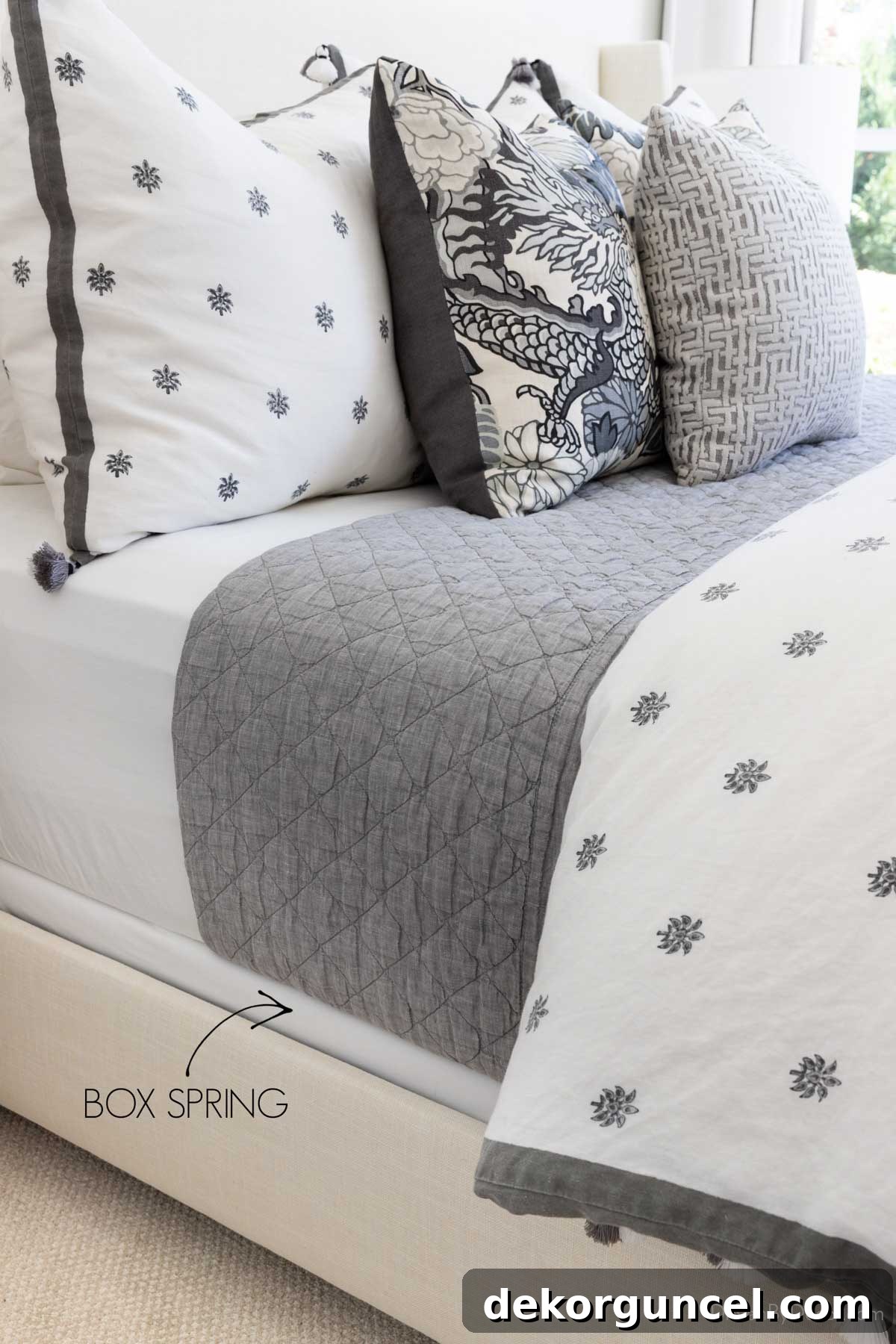
To mask this slight protrusion and ensure a more integrated look, I’ve covered our box spring with a white fitted sheet, allowing it to blend seamlessly with the mattress. However, the ideal scenario, in my opinion, is for the box spring to be completely hidden by the bed’s frame. A 7-inch box spring would achieve this perfect flush fit.
You might wonder about using an even lower box spring, perhaps 4-5 inches high. Unless your mattress is exceptionally thick, I would advise against it. My mattress is 14 inches high, and with my 9-inch box spring, the top of the mattress extends several inches above the bottom of the headboard. This ensures that the portion of the headboard that doesn’t reach the floor remains completely out of sight, maintaining the illusion of a fully upholstered, floor-length headboard:
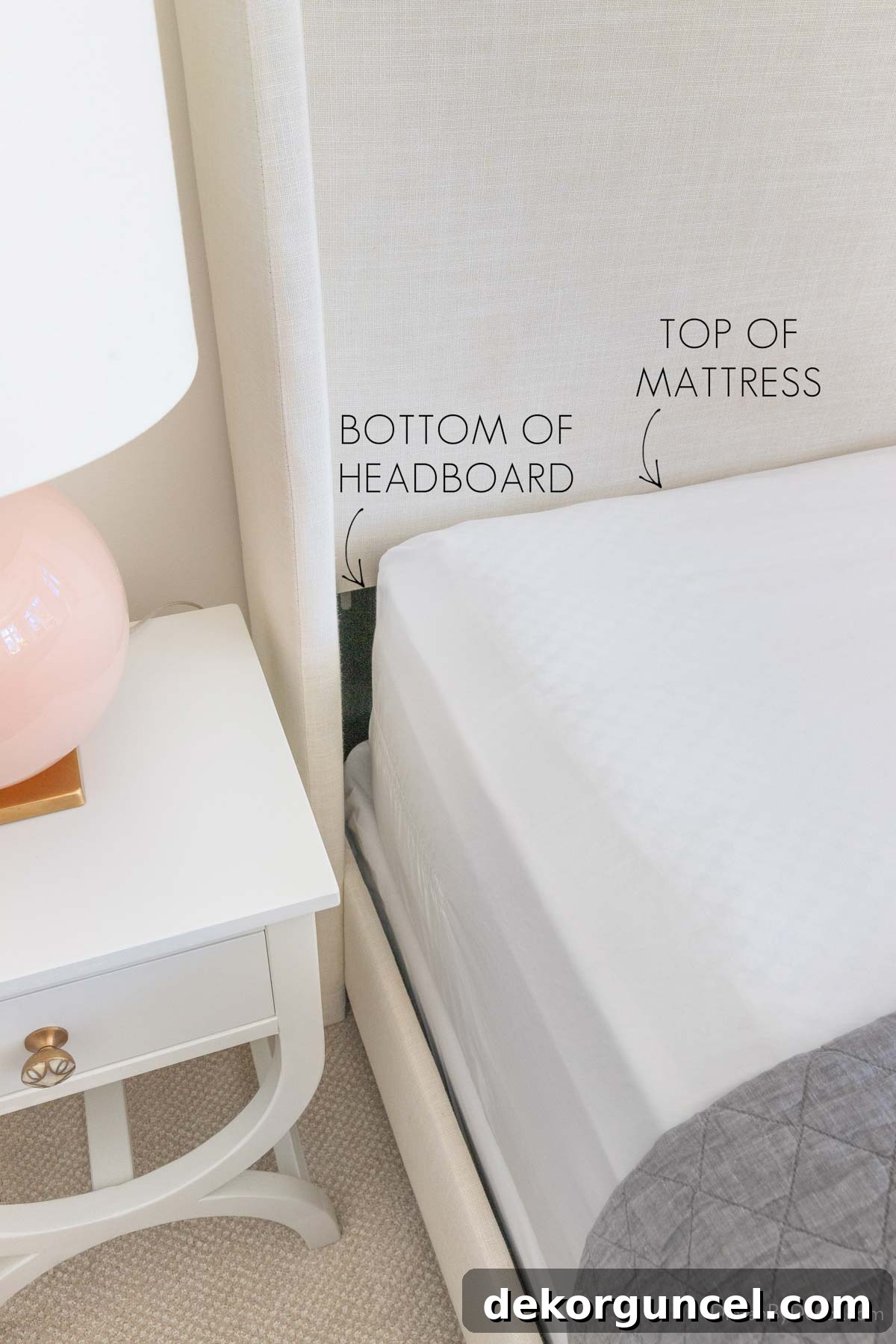
If I were to use a 4-5 inch box spring with my 14-inch mattress, the top of the mattress would fall below the bottom of the headboard, exposing that unsightly gap and detracting from the bed’s polished appearance. Therefore, carefully consider your mattress thickness in conjunction with the box spring height to achieve the best aesthetic and structural outcome.
Does the Tilly Bed Work With an Adjustable Bed Frame?
The compatibility of the Tilly bed with an adjustable bed frame is a common question, and the answer is nuanced. Wayfair officially states that they “do not recommend adjustable bases with any wing-backed headboard as the movement can cause friction between the mattress and wings and potentially damage the fabric and the motor.” This warning highlights potential risks such as wear and tear on the headboard fabric due to repeated rubbing against the mattress or the winged sides, and potential interference with the adjustable base’s mechanics.
However, the real-world experience of many users tells a slightly different story. Over 70 reviewers have explicitly commented that the Tilly bed *did* work successfully with their adjustable bed frames. In contrast, only a handful of reviews mention encountering issues. This suggests a higher probability of successful integration for most users. Many who achieved compatibility did so by adapting the bed frame. One reviewer noted, “This also fit with our adjustable frame that we already had. We just skipped the steps to add the wood supports and our king adjustable frame fit right inside the side rails of this bed.” Another shared, “My Sleep Number adjustable bed is NO problem with this frame! It doesn’t rub on it and it adjusts perfectly even though the description said not to use with an adjustable bed.” A third confidently stated, “We have an adjustable bed and removed the center slats and everything fits perfectly.” These testimonials indicate that with some modifications, like removing the provided slats and carefully positioning the adjustable base within the side rails, compatibility can often be achieved.
In summary, while Wayfair’s official stance is cautious, a significant number of users have successfully paired the Tilly bed with an adjustable frame. If you’re considering this combination, it appears there’s a strong chance it will work, but be prepared for potential minor adjustments and understand that it’s not officially recommended, carrying a slight risk for a small percentage of users.
Tilly vs. Hanson Bed: A Tale of Two Styles
For those deliberating on the Tilly upholstered bed, another popular option that frequently comes into consideration is the {Hanson bed}. This is for good reason, as the Hanson bed is manufactured by the same company and shares an almost identical structural blueprint with the Tilly. The dimensions of both beds are strikingly similar, with the Hanson bed being just one inch taller overall. However, the key differentiator—and the primary factor in choosing between the two—lies in the design of the headboard’s “wings.”
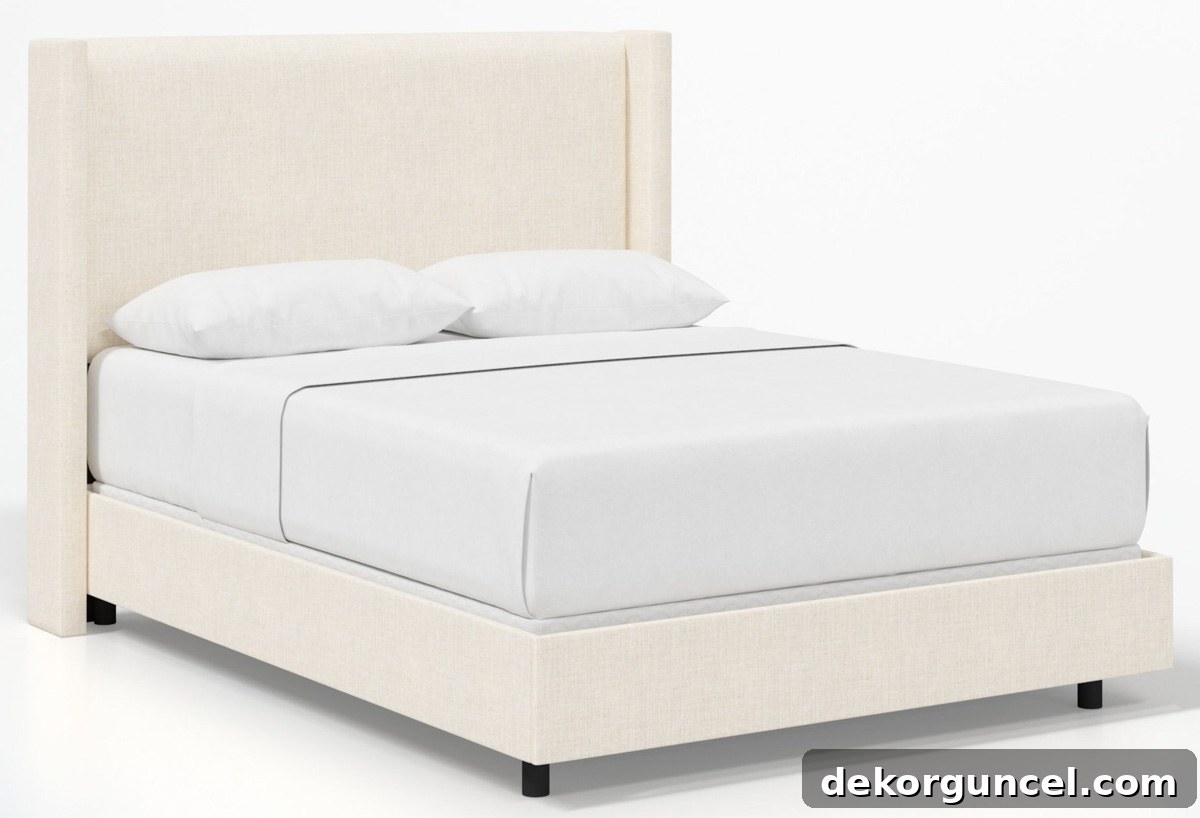
The Tilly bed features beautifully curved wings on either side of its headboard, imparting a softer, more traditional, and undeniably classic silhouette. These gentle curves add a touch of timeless elegance and a hint of stately charm, making the Tilly a perfect fit for bedrooms aiming for a sophisticated or slightly romantic aesthetic. In contrast, the Hanson bed’s wings are straight, offering a cleaner, more streamlined, and distinctly modern profile:
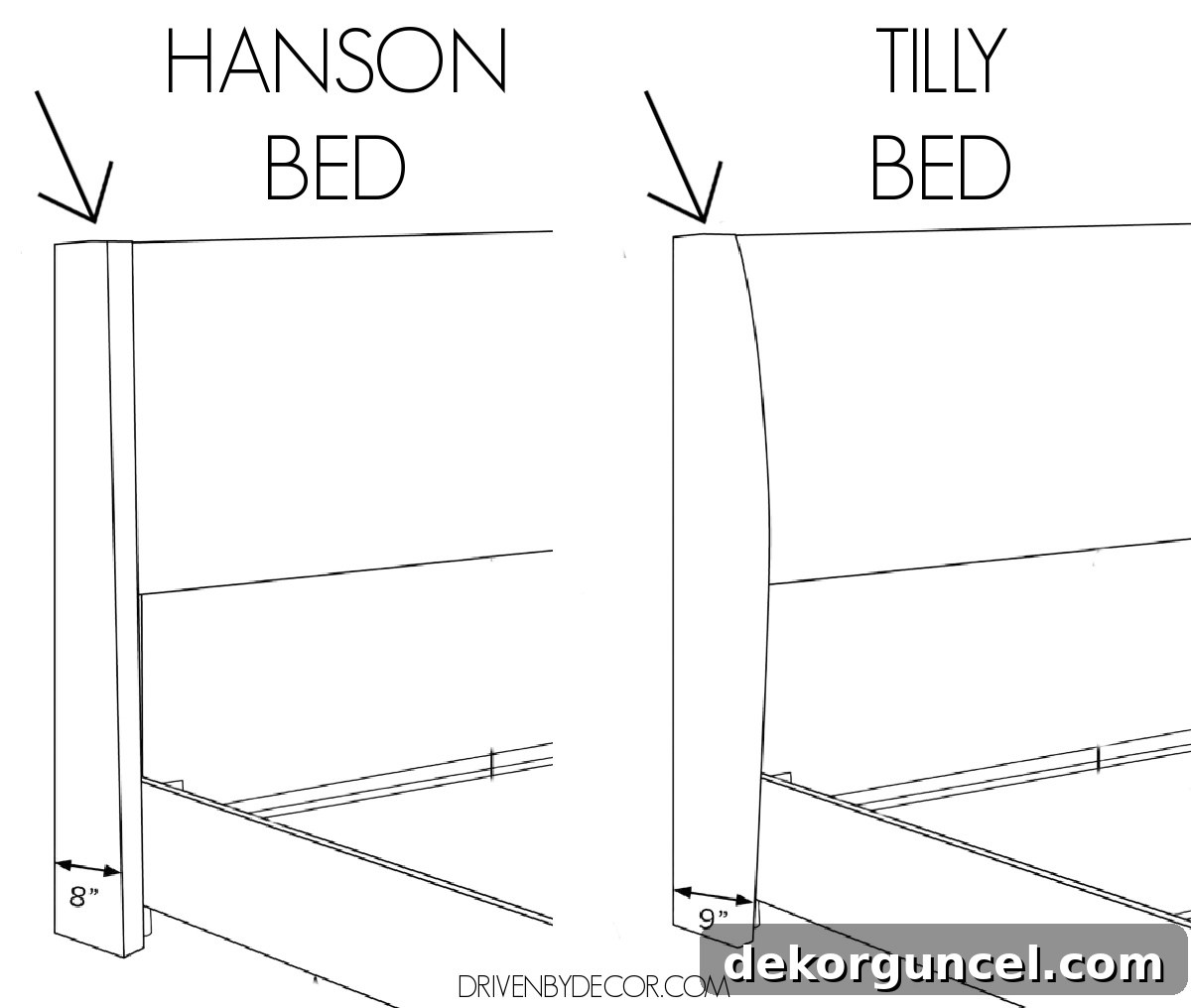
Therefore, the choice largely comes down to your preferred style: the Tilly bed leans into a classic, softer look, while the Hanson bed delivers a slightly more contemporary and minimalist vibe. Both beds maintain the same excellent quality and value, making either an excellent choice depending on the specific aesthetic you wish to cultivate in your bedroom. I personally appreciate the design of both and believe they each offer strong visual appeal.
Exploring Alternatives: Other Upholstered Beds Similar to the Tilly
If the Tilly bed has captured your interest but you’re still exploring options, especially if you’re looking for specific features or a slightly different style, several other upholstered beds offer similar aesthetics or address different needs. For those seeking a higher-end version of the Tilly, particularly with the added benefit of performance fabric options, Pottery Barn’s Harper bed {here} in its non-tufted configuration is an excellent contender. The Harper bed also thoughtfully provides two headboard height choices, 51 inches and 65 inches, allowing for greater customization to suit your room’s scale and your design preferences.
Should your preference be a bed that doesn’t require a box spring—a direct mattress-on-frame setup—the Augusta upholstered bed {here} is a fantastic alternative. Its design features more pronounced curved headboard wings, offering a distinctively softer and more inviting silhouette than the Tilly, while providing robust mattress support without the need for an additional box spring:

Also consider the elegant {Jake upholstered bed}. While it stands at 46.5 inches tall, its design negates the need for a box spring, meaning your mattress sits lower, allowing the headboard to remain sufficiently visible above decorative pillows. For those looking for added functionality, {this wingback upholstered bed} features a clever design with ample storage space underneath, a practical solution for maximizing bedroom organization. Finally, {this upholstered bed} stands out for its consistently positive reviews and excellent pricing, presenting another strong value proposition (it’s also available in a queen size {here}). Each of these alternatives offers unique benefits, allowing you to find the perfect upholstered bed to complete your bedroom vision.
If you’re still exploring other bed options, including those beyond upholstered styles, I highly recommend checking out my dedicated post on affordable beds, which features several other well-priced favorites and diverse styles.
I sincerely hope this detailed review of the Tilly Upholstered Bed has been helpful in your search for the perfect bedroom centerpiece. Choosing furniture, especially a bed, is a significant decision, and I aim to provide you with all the insights you need. If you have any further questions or need additional clarification, please don’t hesitate to ask! For those new to purchasing furniture online, you might also find my guide on how to buy furniture, complete with my ten best online shopping tips, incredibly useful for a smooth and successful experience.
